
automate your business
Team AI All-Stars
A platform where businesses build teams of AI agents that handle email, research and scheduling on their own. People approve the actions that matter, every run is recorded and each customer's data stays separate.
- Timeline
- One Month
Overview
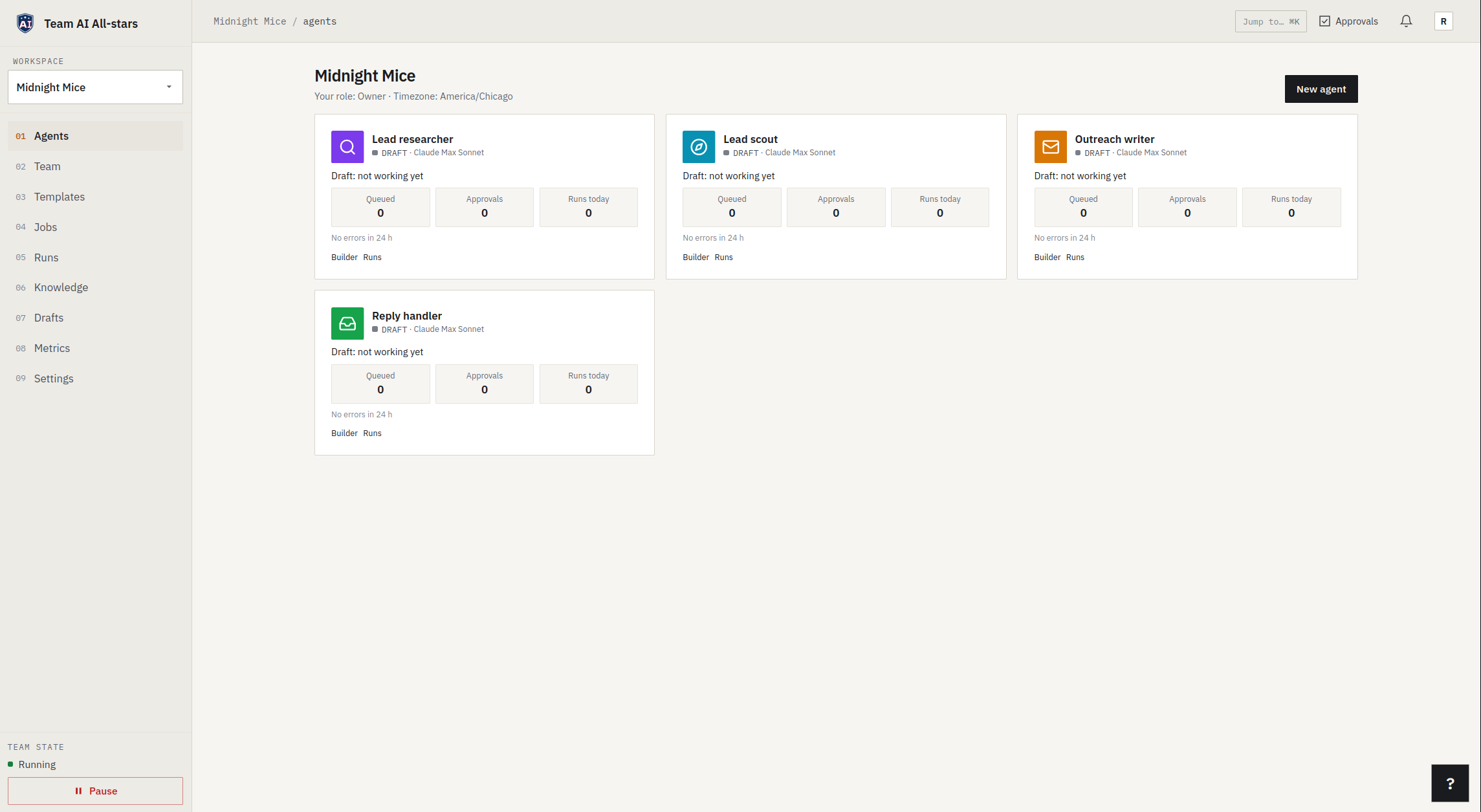
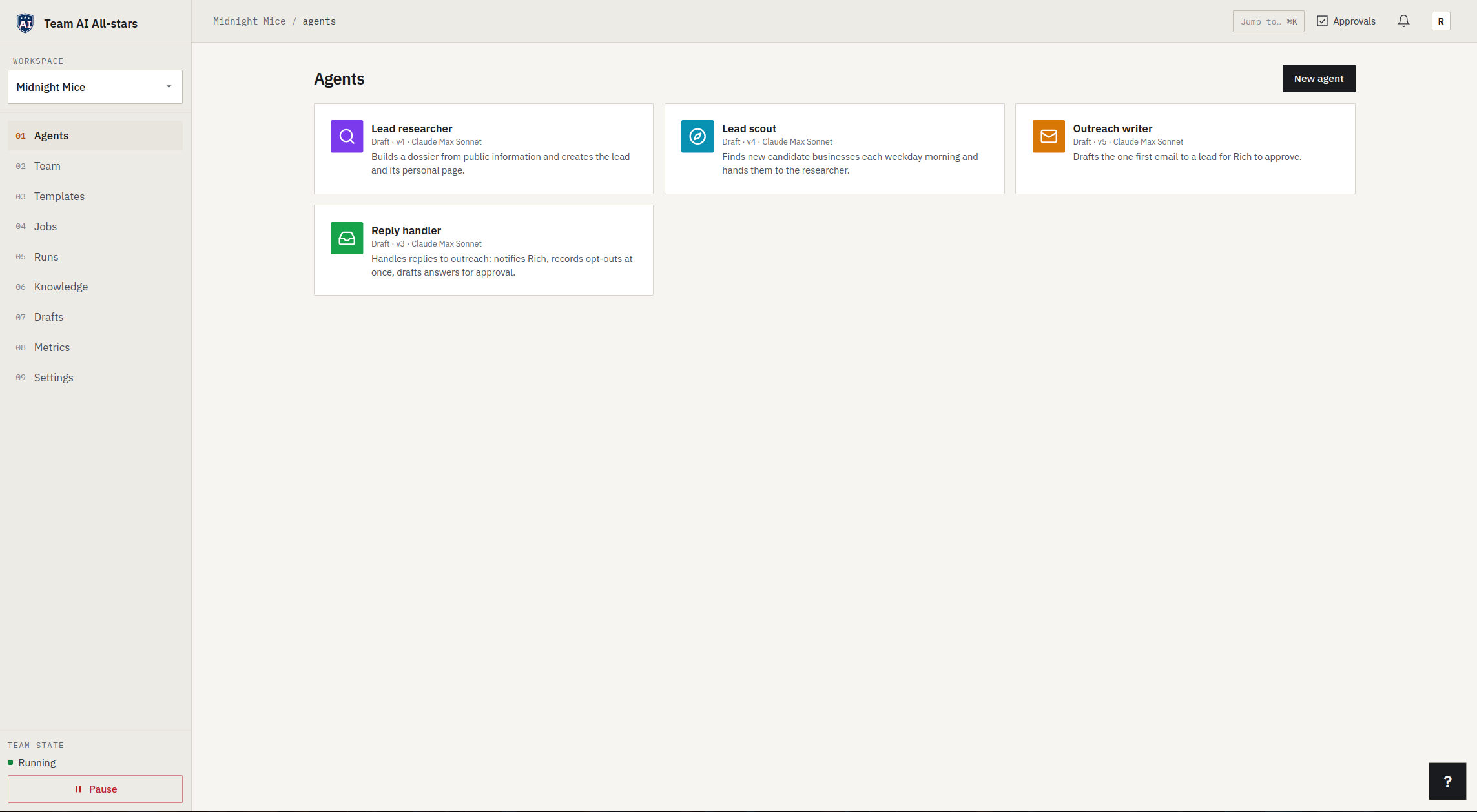
Midnight Mice built Team AI All-Stars, a self-hosted platform where a business builds a team of AI agents and keeps a person in charge. Each workspace is separate from the others. An agent has a role, a set of tools, its own knowledge and an email address. It can read and answer mail, research the web, book calendar events, hand work to a teammate or look up a customer's data. Anything risky waits for a human to approve it. Every action is recorded, and the platform runs on the studio's own servers with local or hosted models.
The challenge
Small and mid-sized teams are being sold AI assistants they can't trust or check. Most tools run in someone else's cloud, hide what the model did and can send an email or change a record on their own. A team that wants help with support inboxes, follow-ups or scheduling has to choose between handing over control and doing the work by hand. Those who have tried agents also found that the agents drift off topic, repeat themselves or act on instructions hidden inside an email.
Goals
- Give each business a team of specialised agents that work by themselves on routine jobs. - Keep people in control. Sensitive actions need approval, spending is capped and any agent can be paused at once. - Keep every customer's data, agents and connections separate. - Run on our own infrastructure, with a choice between local and hosted models, so private data stays private. - Make the work visible: a step-by-step record of each run, with the reasoning, tool calls and outcome. - Explain the platform in plain language to the clients and customers who receive its email.
The approach
1. Foundation. A multi-tenant Django and PostgreSQL platform in which every record belongs to a workspace and is scoped automatically. Sign-in uses two-factor authentication. A single model gateway handles routing, privacy and budget checks and keeps a ledger. 2. Agents that act. A run engine that records each step before acting, so a crash can be replayed and an unfinished send is never repeated. Agents get tools for email, calendar, web search, knowledge, files and outside APIs. Teams of agents work through a router that hands work to specialists. Handoffs share references and never pass on authority. 3. Guardrails first. Outside text, such as an email or a web page, is treated as untrusted data and can't switch tools on or add recipients. Replies go only to the sender, unknown recipients need approval, and daily and per-thread limits catch runaway sends. An outgoing-mail check refuses placeholders and wrong weekdays. 4. Hardened operations. Native services under systemd behind nginx, secrets in encrypted connections, a strict content security policy, narrow sudo and key-only SSH. 5. **Polish and openness.** A dark and light console with an approvals inbox, metrics, templates, a help assistant and a public site that explains the platform. The Team AI front desk answers questions about the platform itself, by email, on the platform.
What was delivered
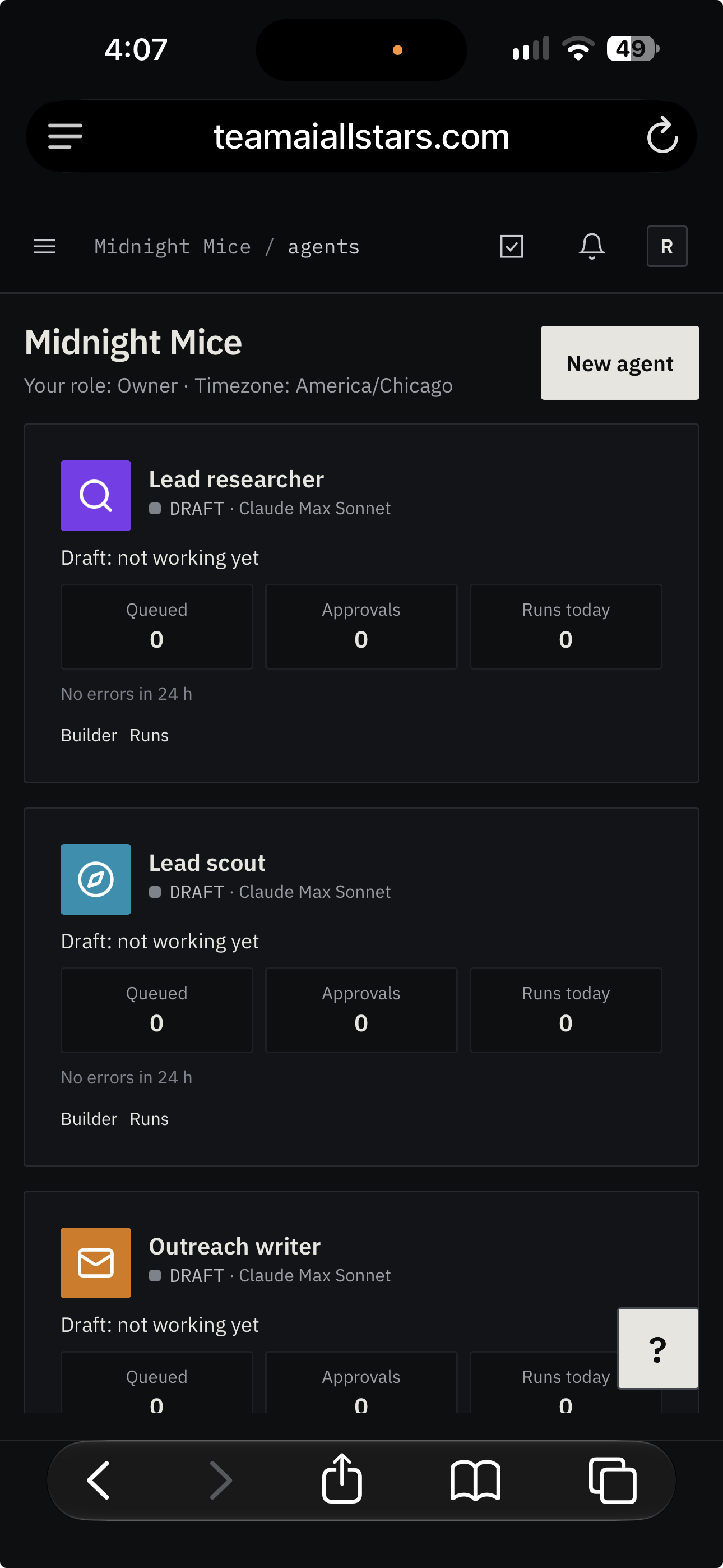
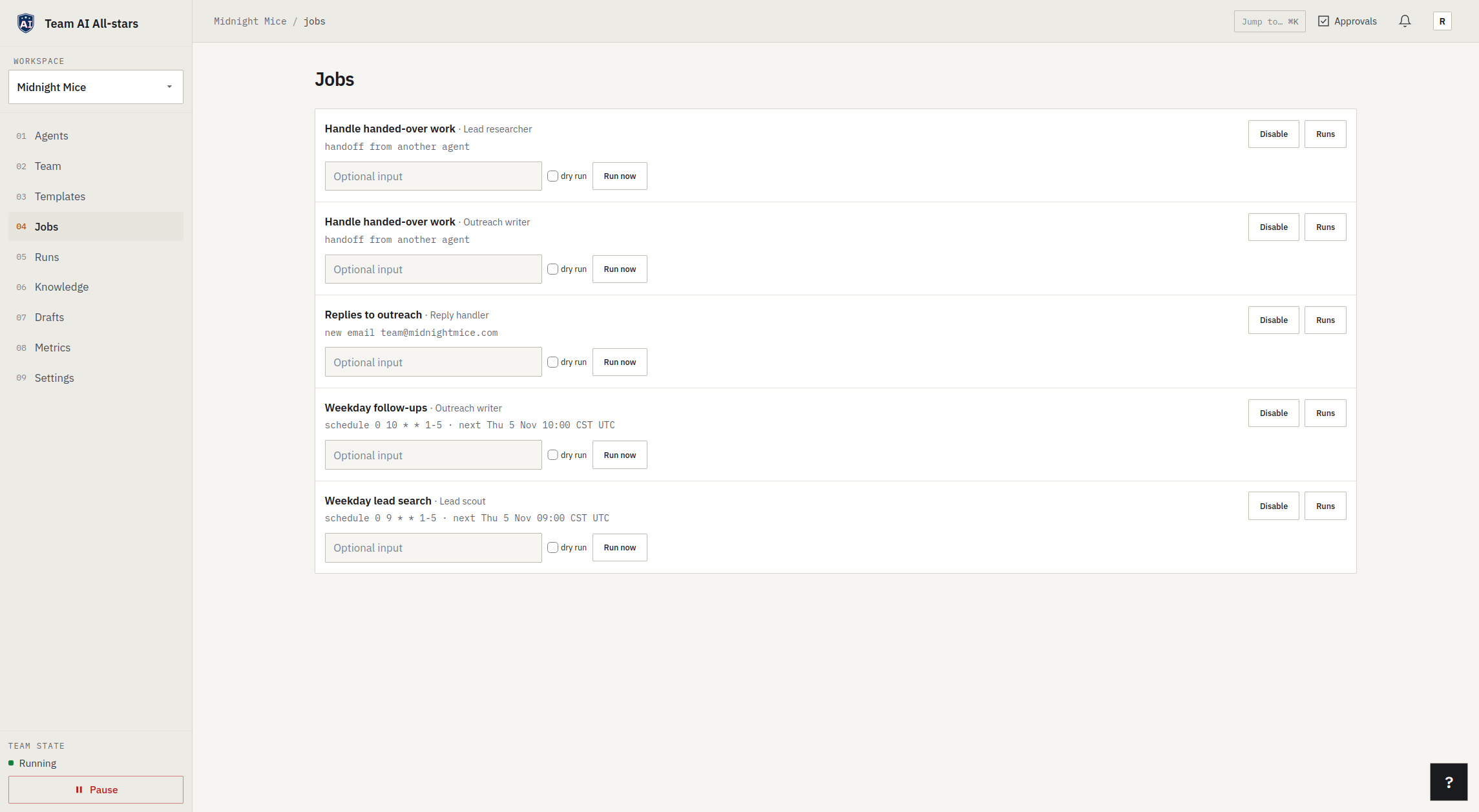
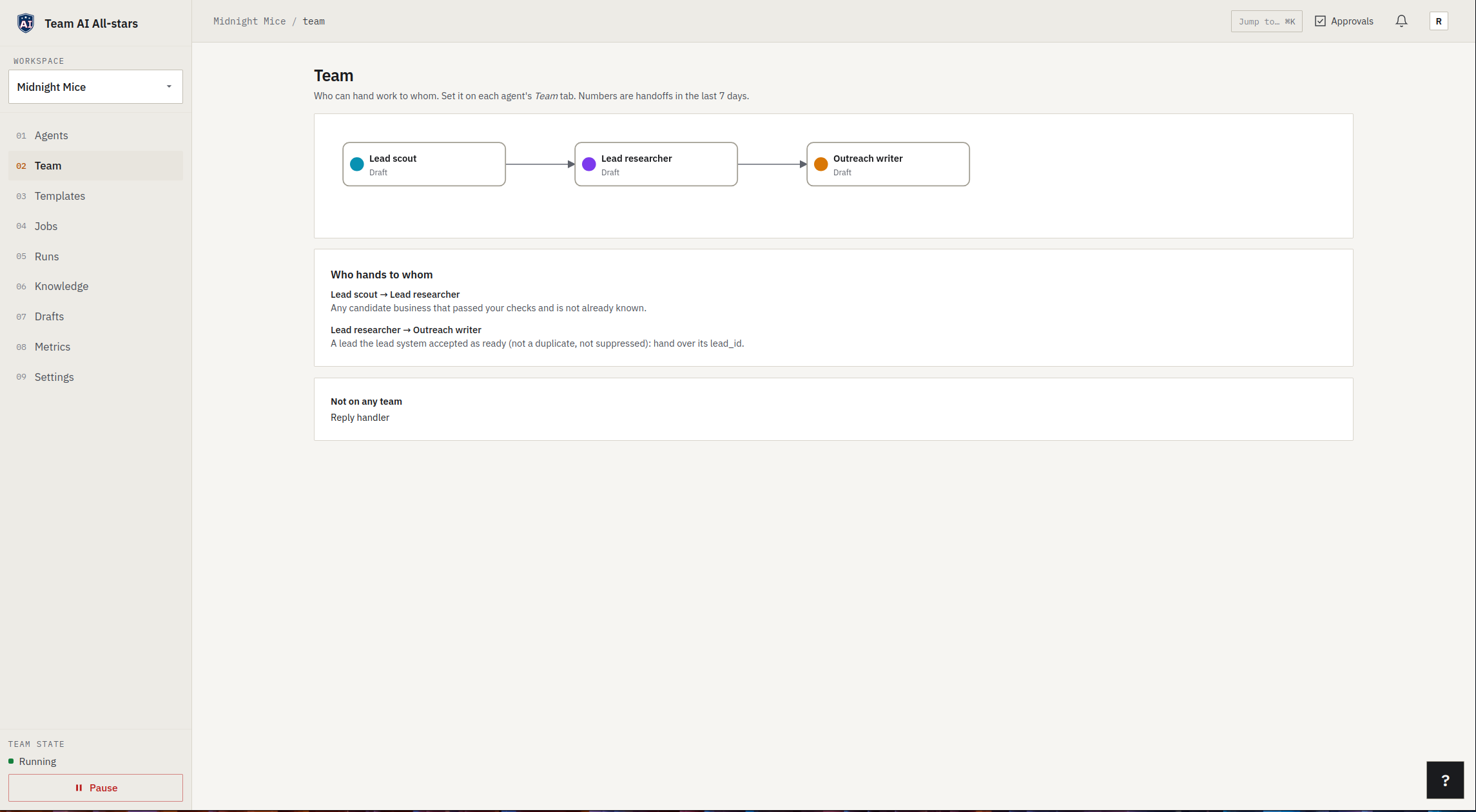
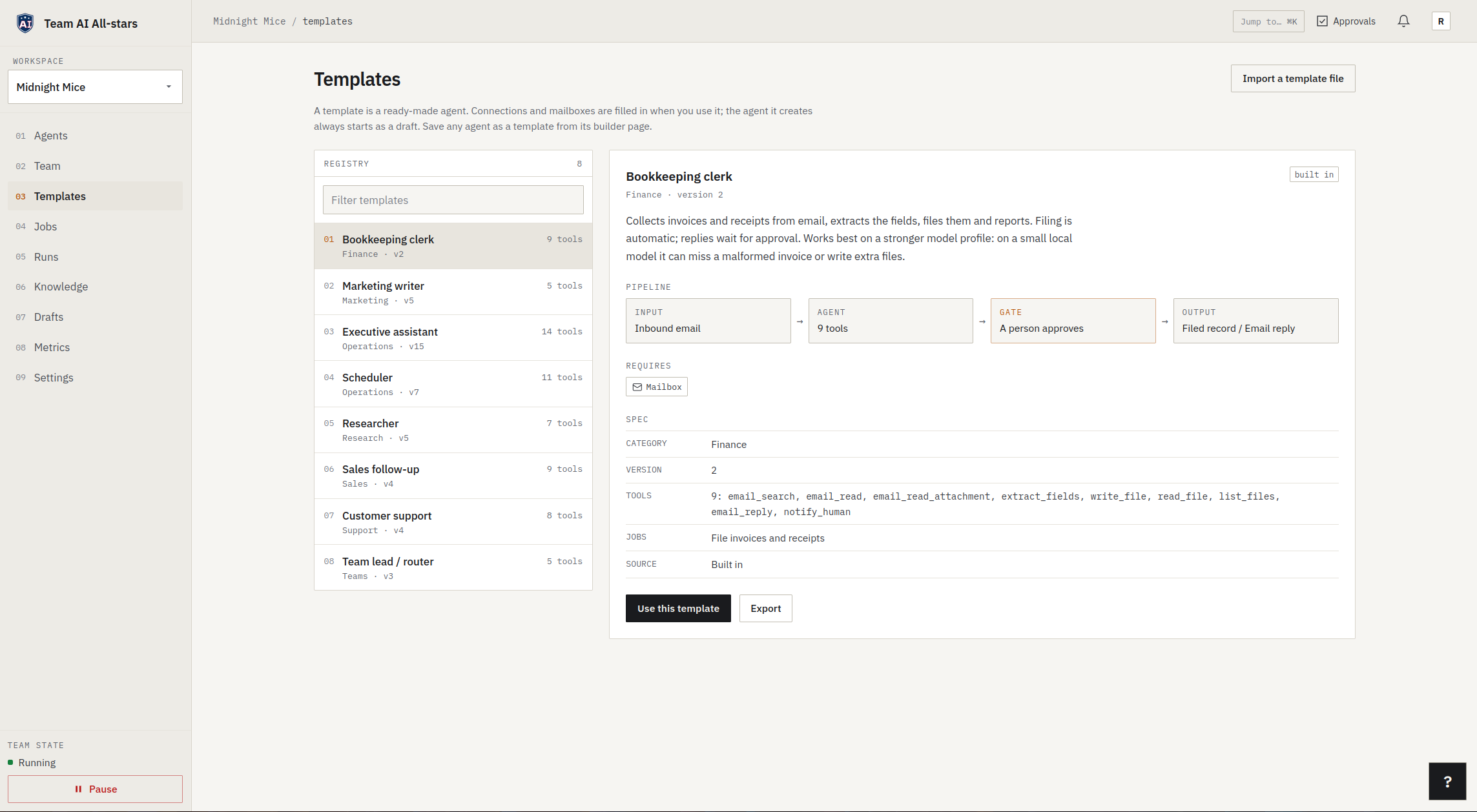
- Multi-tenant workspaces with roles, invitations and two-factor sign-in - Agent builder with versioned, pinned configurations, plus ready-made templates - Run engine with a full step timeline, re-run for failed runs, approvals and escalation - Router and specialist teams with controlled handoffs - Email tools for Gmail, Microsoft and IMAP/SMTP, including agent mailboxes provisioned on our own mail server - Calendar scheduling through a bridge or a mailbox - Knowledge collections with search and agent memory, using local embeddings - Web search and page fetch with domain allow-lists - Connections vault for model providers, mail, APIs and a Claude Code runner, shared across workspaces on request - Guardrails: approval rules, daily caps, rate and hour limits, blocked topics and trusted senders - Cost and privacy controls: per-workspace budgets, a ledger without message content and local-only pinning - Webhook and schedule triggers with routing and de-duplication - Operations console with metrics, daily digest, notifications and an audit log - Dark and light themes with phone-friendly layouts - Public site (home, features, safety, FAQ, privacy, terms) written in Markdown - In-app help assistant that answers from the product guide - Deployment, backup and restore scripts for a self-hosted setup
Results
- Teams can hand routine email, research and scheduling work to agents. They approve only the actions that matter. - Each run leaves a readable record, so a manager can see what an agent did and why, and re-run it if it failed. - Customer data stays on infrastructure the team controls, with local models available for private work. - Midnight Mice runs its own front desk on the platform. An agent answers questions from anyone who emails it, stays on topic, and passes account requests to a person. - The same platform now runs several workspaces for the studio's other products and outreach, each with its own agents and limits.
Gallery
Want something like this for your business?
A 30-minute call to talk through how your business runs today. No pitch deck, no pressure.